
By learning from past disruption, universities can deliver a premium learning experience



D2L
The disruption caused by Covid-19 has forced universities to adapt quickly. But this has also allowed for innovation at a pace that previously seemed impossible.
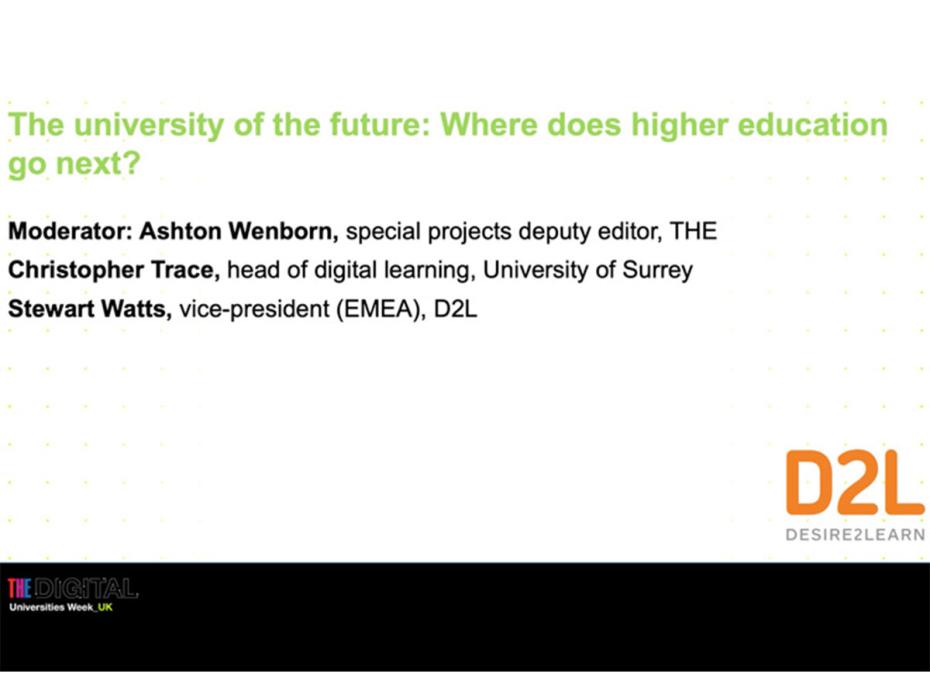
During a virtual panel session for ĢĒŠÄVlogā€™s , experts from academia and industry met to discuss what universities have learned from their experiences over the past 18 months, and what that means for the future.
Christopher Trace, head of digital learning at the University of Surrey, said plenty of positives could be seen in remote learning and from universitiesā€™ emergency online response. ā€œThe huge silver lining around the cloud that is Covid isā€¦the surge weā€™ve seen in staff and student digital capabilities,ā€ Trace said. ā€œUsing technology to solve problems has been a real eye-opener and many institutions, including our own, have talked about enhancing education and changing things for the better.ā€
Stewart Watts, vice president of EMEA at D2L, added that the shift in attitudes seen during the pandemic has allowed universities to become more agile. ā€œThere is far less bureaucracy ā€“ they are making decisions much quicker, akin to the corporate world ā€“ which I think needed to happen and will be here to stay,ā€ Watts said.
The pandemic has also emphasised the growing need for upskilling ā€œboth of academics and the general workforceā€, Watts added.
To meet these needs, universities must continue to build relationships with businesses. Many are already seeing a greater industry presence on campus, panellists agreed.
Here, new technologies can help, Trace said: ā€œOnline and hybrid learning can be refined through technology to provide personalisationā€¦Each learner can study at their own pace in their own way, and automation [of bureaucracy] will mean that teachers still have time to coach online as well as give that personalised experience.ā€
From D2Lā€™s perspective, technology is playing a bigger role in nurturing student employability, Watts said. ā€œWeā€™re looking at technologies that support the development of soft skills, for example, the ability for students to record themselves doing a presentation and then analyse that performance automatically to give them feedback on things like filler words used.ā€
Collaborating with industry on course design and nurturing interdisciplinary skills were a priority for providers on both sides, Watts added. ā€œI think weā€™re getting there, and I think thereā€™s going to be more collaboration to make sure that the skills required in the world of work are being properly built-in,ā€ he concluded.
Watch the session on-demand above or on the .
