
How I used chalk and paper to win back students’ attention


You may also like
Popular resources
It’s that time of year when course evaluations come in. Last semester, I banned laptops from my undergraduate course, and I wasn’t sure how this, and other analogue-forward changes I made, would be received. I did it in response to new technologies and out of a desire to help students engage more deeply with the material.
These bets were grounded in a mix of research evidence and intuition. And the evaluations have come in, I’ve seen that students have been largely positive towards them.
Here are four bets I made in my large lecture course of 125 undergraduates that might be applicable and adaptable to other courses as well.
Bet 1: No laptops
I previously permitted students to use their devices because everyone does it in college classrooms. Of course, I’ve seen them scrolling through Amazon, rearranging their Google calendar and even watching NBA reels, but I thought I shouldn’t be policing how they take notes.
But I changed this. At the start of this semester, I said: “This is a no-laptops classroom for reasons X, Y, Z. If you have accommodations, please email me.� The rationale was straightforward. A growing body of suggests that laptop-free classrooms improve retention, academic performance and quality of discussion. One found something even more striking: when students nearby used laptops for non-class activities, their peers’ learning (not just their own) suffered.
- What are students really paying attention to?
- Spotlight guide: Course design for a new age
- The Democracy Lab: how 20 minutes of debate can revive the lecture
But how did my students react? In my mid-course evaluation, 75 per cent of students said that the practice helped them, and 23 per cent said that they felt neutral about it. Only two students didn’t like the rule. In my final course evaluation, several students noted how they weren’t distracted by others and could concentrate better.
Two other practices helped make this policy work. First, I shared the slide deck with students before class, so they could focus on listening and note-taking rather than trying to capture every detail of my slide. Second, I built enough time into class for students to handwrite their notes, rather than rushing them through the material.
Bet 2: Back to chalk
I used to rely on slides while occasionally writing concepts on the board. However, in an age when my slides could be made by generative AI (they aren’t), I thought about what would set my teaching apart.
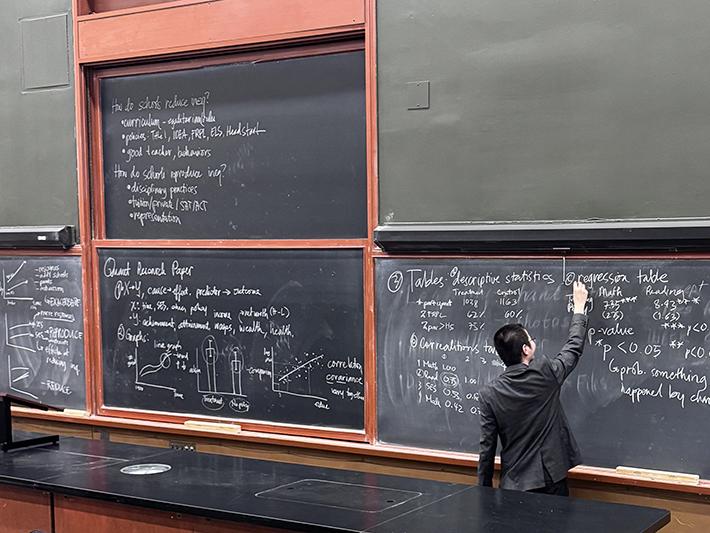
One day, I decided to walk into our large lecture hall with nothing but a piece of chalk. I prepared a slide deck as a back-up, but I challenged myself to teach for 90 minutes from memory. I knew the main ideas I wanted to cover, but beyond that, the class would unfold in a way that more closely resembled an improvised performance. I structured the discussion, posed questions, wrote students’ responses on the board, introduced new concepts and watched ideas gradually come together. Placing ideas together had a certain choreography and artistry.
In the course evaluation, students noted how much they liked the chalk talks. One wrote: “It was a lot more interactive and easier to understand, rather than just writing in our notebooks off of the screen.�
I learned one thing quickly: this approach only works if the instructor is exceptionally prepared. Without slides to provide structure, I had to be crystal clear about the key concepts and how the lecture progressed. Often, I would meticulously outline them in advance to prevent the discussion from meandering. I’ve also developed better and larger penmanship.
Bet 3: Handwritten homework
Like many faculty, I am concerned that students will depend too much on GenAI to do their work, their reading and, ultimately, their thinking. A recent showed that 95 per cent of college faculty fear students’ over-reliance on these tools.
While not completely AI-proof, one strategy is to ask students to handwrite a concept from a reading for that week on a piece of paper. It is less demanding than a summary, as I just want them to focus on defining, applying and discussing one idea. And it’s a low-stakes way to get students to read. Yes, AI might write the concept note for them. But at least they do the physical act of writing what the machine tells them.
In evaluations, students appreciated this activity, with one writing that they “liked the concept notes as they forced me to have an overview and general idea of the topic for the week�.
To make this practice effective, instructors must explain the rationale to students. I tell them why I ask them to handwrite concept notes before class; the goal is to help them stay accountable to themselves, complete the reading and come to class ready to participate in the discussion.
Bet 4: Multiple-choice final exams
One concern that has been on the radar recently is grade inflation. Harvard has created a new to limit the number of As given to students in a course. This made me reflect not so much on grades as about what I should assess in my courses.
I’ve noted three things I should assess: students’ efforts (manifested in coming to class and accomplishing requirements), their improvement (their growth during the course), and their mastery of knowledge and skills. In thinking about mastery, I found myself compelled to have sit-down final exams, where there were objectively right and wrong answers. While I still have essay questions, I’ve found that multiple-choice exams provide a way of noting which students truly mastered the concepts.
Of course, some students are not good at multiple-choice exams (I’m probably like them). So, I do two things: if a student has consistently come to class and done the work, a low mark in the exams will not lead to an F. More importantly, I permit students to bring a one-page handwritten cheat sheet. This reduces anxieties for students who might forget concepts and helps students prepare for the exam.
Now, many counterarguments and practical constraints could be raised around limiting laptop use, using chalk, assigning handwritten homework, and relying on multiple-choice exams. Concerns about inclusion and accommodations are important, as are questions about feasibility and student autonomy. What I’ve learned, however, is that these challenges can often be addressed through thoughtful exceptions and careful flexibility. All said, these bets are frequently worth it.
The next bet? Printed readers
Looking forward to next semester, when I’ll teach a small seminar course on the liberal arts, I’ll be providing students with printed readers that contain excerpts from Aristotle’s Nichomachean Ethics, ¶Ù²¹²Ô³Ù±ð’s Inferno and Martha Nussbaum’s Cultivating Humanity, among other texts. They’ll be reading on physical paper, annotating pages and coming to class with their highlighted copies.
Let’s see if this new bet will yield returns.
Jose Eos Trinidad is an assistant professor of education and organisational studies at the University of California, Berkeley.
If you would like advice and insight from academics and university staff delivered direct to your inbox each week, .
